
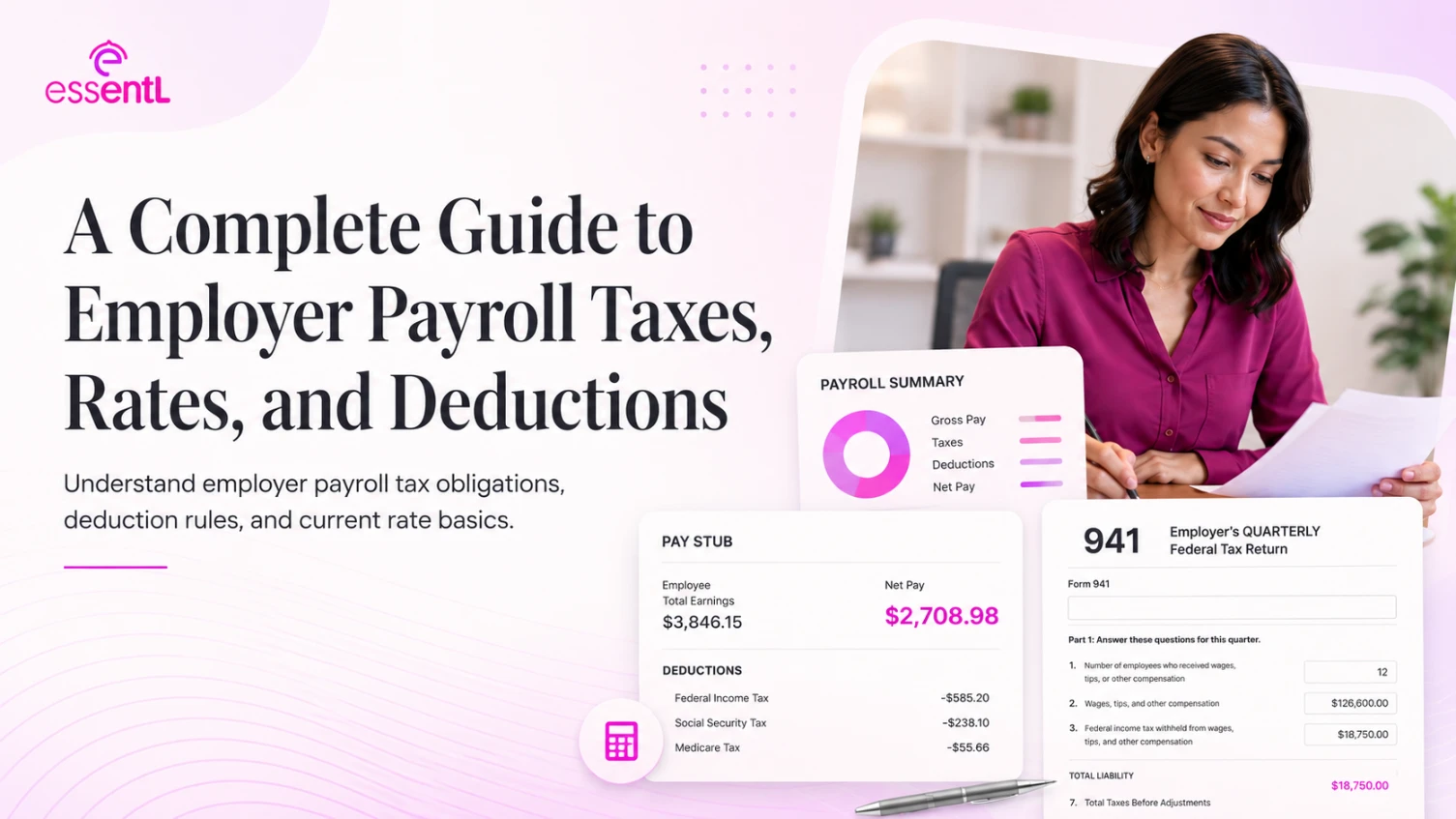
Stepping into the role of a founder usually means you expect to focus on product design or closing sales deals, not mapping payroll tax withholdings. Yet, the moment you hire your first employee, you are handed an invisible ledger of federal, state, and local compliance demands. A single miscalculated deduction or a missed deposit deadline can instantly derail your operational focus with heavy penalties.
In this guide, our team at essentL PEO strips away the accounting jargon to break down what is in payroll tax, how to calculate employer payroll taxes, and how to track your ongoing payroll liabilities so you can confidently keep your business protected.
What is Payroll Tax and How Does It Affect Your Business?
Payroll taxes are the mandatory taxes that employers and employees pay on wages, tips, and salaries to fund social insurance programs like Social Security and Medicare.
Picture this, you’ve been working late for weeks to build a great team culture, only to realize your back-office math is completely exposed because you forgot to track a localized payroll tax update. Unlike standard income taxes that employees settle once a year in April, payroll taxes must be calculated, withheld, and deposited during every single pay cycle you run.
What is In Payroll Tax Components?
To understand how this affects your cash flow, look at it as a two-way street split cleanly between:
- Employee Withholdings: The money you deduct directly from your team’s paychecks to send to the government on their behalf.
- Employer Obligations: The matching funds that your small business must pay directly out of its own bank account above and beyond the employee’s gross wage.
What Are Payroll Deductions and How Do They Shift Net Pay?
Payroll deductions are any amounts withheld from an employee’s gross pay to arrive at their final net “take-home” pay.
Let’s look at a quick example: Suppose you hire a top-tier project manager named Sarah for a gross salary of $5,000 a month. When payday arrives, Sarah doesn’t actually see $5,000 hit her bank account. Instead, her check reads $3,850. The missing $1,150 hasn’t vanished, it has been carved up into multiple mandatory and optional slices before it ever leaves your business account.
Statutory vs. Voluntary Deductions for Small Businesses
Our research showed that small business owners frequently confuse mandatory payroll tax deductions with optional workplace programs. Here is how they break down:
- Statutory Deductions (Mandatory): These are non-negotiable legal withholdings, including federal income tax, state income tax, and local taxes. In Sarah’s case, this makes up the bulk of that $1,150 reduction.
- Voluntary Deductions (Optional): These are employee-authorized cuts for workplace benefits. If you want to keep your top talent from looking elsewhere without draining your time, you can explore how we build competitive, Fortune 500-level health and wellness plans tailored specifically for growing small businesses, which are handled right here as a pre-tax voluntary deduction from Sarah’s check.
What Are Employer Payroll Taxes and How Are They Calculated?
Employer payroll taxes are the specific taxes that you, the business owner, must pay out-of-pocket as a legal cost of employing people. You cannot deduct these specific amounts from your workers’ salaries.
Going back to our example with Sarah: even though you deducted money from her check for her payroll taxes, the government also requires you to match those funds using your company’s money.
The Federal Insurance Contributions Act (FICA)
FICA requires a matching contribution system. The standard payroll tax rates dictate that both you and your employee pay a matching 6.2% for Social Security and a matching 1.45% for Medicare, making the baseline employer payroll tax rate 7.65% on eligible wages.
So, because Sarah earned $5,000, you must write a separate check out of your company bank account for $382.50 (7.65% of $5,000) to match her contribution.
Keep in mind that the Social Security portion (6.2%) only applies up to the annual Social Security wage base limit, which is $184,500 in 2026. Once an employee’s year-to-date earnings pass $184,500, then you and the employee stop paying the 6.2% Social Security tax for the rest of the calendar year (though the 1.45% Medicare tax continues uncapped on all earnings).
The Federal Unemployment Tax Act (FUTA)
FUTA is an exclusive employer obligation that funds unemployment compensation. The standard baseline rate is 6.0% on the first $7,000 of an employee’s annual earnings, though small businesses that pay their state unemployment taxes on time typically receive a tax credit that drops this federal rate down to 0.6%.
Important Exception for California Employers:
According to the California Employment Development Department(EDD), due to California’s unpaid $21.3 billion federal unemployment loan, the standard 5.4% FUTA tax credit is reduced by 1.2%, raising the net tax rate from 0.6% to 1.8% ($126 total per employee). Because California remains in default, this credit drops by an additional 0.3% every year, increasing FUTA costs annually for California businesses until the state repays its debt.
State Unemployment Taxes (SUTA / SUI)
SUTA (State Unemployment Tax Act) is an employer-paid state payroll tax that funds temporary unemployment benefits for workers who lose their jobs through no fault of their own. Unlike federal unemployment taxes, each state establishes its own tax rates, experience-based adjustments, and maximum taxable wage base limits.
Unlike the flat federal baseline, SUTA rates are personalized for every business based on an experience rating (how many former employees have filed unemployment claims against your company) and industry risk. Additionally, paying your SUTA liabilities in full and on time is what grants you the 5.4% federal FUTA tax credit, reducing your net federal rate down to 0.6%.
Note: Taxable wage bases vary state by state Unlike FUTA, which taxes a fixed $7,000 baseline nationwide, SUTA taxable wage bases are set individually by each state and update annually.
While states like California, Florida, and Tennessee stick to the federal baseline cap of $7,000 per employee, others set their thresholds significantly higher to support state trust funds, such as New York ($17,600), Colorado ($30,600), and Washington State ($78,200 in 2026). If you operate in multiple states, you must track each state’s specific wage base limit to avoid underpaying local payroll taxes.
What Are Payroll Liabilities and Why Do They Keep Owners Awake at Night?
Payroll liabilities are the total accumulated amounts of payroll taxes and deductions that your business has withheld but has not yet officially deposited to the IRS or state tax authorities.
Consider this scenario: Sarah’s withheld payroll taxes and your matching employer taxes are sitting together in your operational checking account. It looks like available cash, so you use it to buy a new batch of office equipment or pay an agency invoice. Two weeks later, the IRS demands their deposit. Suddenly, you’re short on cash and facing an automatic audit.
Holding this money in your primary bank account without a strict separation protocol is an administrative trap. Understanding how these ongoing cash obligations interact with your everyday cash flow is a vital pillar of scaling a business safely, a process we explore heavily in our foundational blueprint on What is a PEO.
Managing the Filing Deadlines
Depending on the size of your payroll, the government expects you to clear out your payroll liabilities on a semi-weekly or monthly schedule. Missing a single deposit window by even a day triggers automatic interest charges and late-deposit penalties that eat into your profit margins. If you are trying to calculate the true cost of managing these cycles internally versus outsourcing the operational risk, you can review our transparent membership pricing plans.
Understanding Payroll Liabilities and Managing Compliance Risks
The administrative burden of calculating variable payroll tax rates, submitting accurate tax forms, and tracking changing state regulations is an operational bottleneck that stalls small business growth.
Our team at essentL PEO built a co-employment alternative that takes the payroll tax compliance weight completely off your shoulders. We handle every single calculation, automate your employee deductions, and assume the legal responsibility for filing your employer payroll taxes on time and without errors. By letting our professionals absorb your payroll liabilities and administrative labor, you protect your bottom line and give your team the freedom to focus entirely on scaling operations.
Big-company health benefits at small business rates.
Conclusion
Mastering what are payroll taxes, rates, and deductions are non-negotiable if you want to run a healthy, compliant business. By mapping out your FICA matches, tracking your FUTA and SUTA caps, and cleanly separating your operational funds from your payroll liabilities, you establish a baseline of financial security. Look for structured systems, expert human support, and clear compliance boundaries and your small business will navigate the payroll tax landscape successfully.