Building a small business from the ground up usually forces you to piece together your administrative backend on the fly. You buy a standalone software tool to track employee hours, use a completely separate portal to handle employee onboarding paperwork, and rely on standard spreadsheets to track employee benefits. This fragmented approach fails once your business begins to grow.
In this guide, our team at essentL PEO breaks down why separating your systems is a mistake, how seamless payroll integration protects your compliance, and why unifying your back office gives your growing small business a foundation to thrive.
Why Do Separate HR and Payroll Systems Risk Your Operations?
When your core human resources data and your actual payroll processing engine don’t talk to each other, your small business is forced to bridge the gap with manual, error-prone data entry.
Think about it, you spend hours collecting onboarding documents, only to log into a completely different platform to re-type the exact same names, routing numbers, and payroll tax exemptions. When a small business operates this way, a single typo can lead to missing paychecks, incorrect payroll tax withholdings, or regulatory penalties.
The True Cost of Disconnected Systems
Our recent findings highlight that small business owners lose dozens of hours every month simply maintaining duplicate records because they treat payroll and HR as two entirely separate departments.
- The Onboarding Friction: A new hire fills out their paperwork, but because of a delay in manual data entry, their initial pay cycle gets delayed.
- The Tracking Nightmare: When an employee receives a salary increase, a manager must remember to update both the internal directory and the processing portal perfectly.
- The Compliance Gap: If an address change is updated in your records but missed in your processing system, your state payroll tax filings will be submitted incorrectly.
What is a Payroll Integration and How Does It Protect Small Businesses?
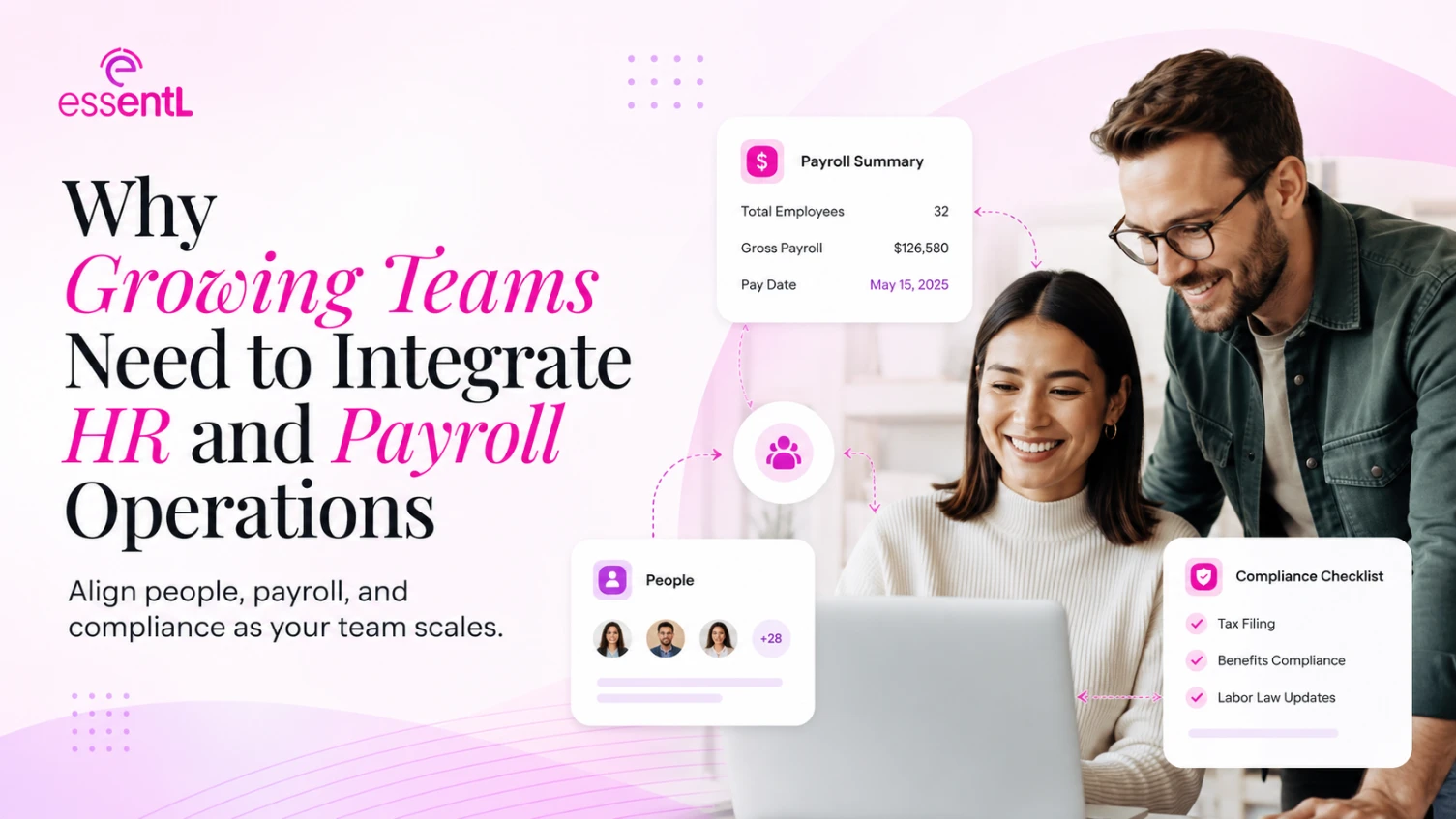
True payroll integration means merging your employee database, benefits administration, time tracking, and payroll tax execution into a single, unified ecosystem where your HR and payroll data flows naturally.
Let’s look at a quick example: Imagine a growing marketing agency that just scaled from 5 to 25 employees. Under the old, fragmented system, every single promotion or health insurance adjustment required manual validation across multiple screens.
With modern payroll integrations, the second a change is approved in the employee profile, the system automatically adjusts the calculations for the next pay cycle without a human ever needing to duplicate the work.
The Strategic Value of Unified Data for Small Businesses
Our team’s study showed that when your payroll management and HR functions as one single unit, you eliminate the operational lag that hurts growing teams.
- Flawless Time-to-Pay Mapping: Hourly clock-ins map directly to the pay cycle, preventing manual adjustment errors.
- Seamless Benefits Deductions: If an employee signs up for insurance, their pre-tax deductions are automatically configured. If you want to keep your top talent from looking elsewhere without draining your time, you can explore how we build competitive, Fortune 500-level health and wellness plans tailored specifically for growing small businesses, which integrate effortlessly into a unified administration setup.
- Specialized Workflow Visibility: Unifying your baseline operations also makes it much easier to track the strict financial math required for compliance, such as keeping up with federal withholdings and matching contributions, which we break down heavily in our deep-dive playbook, A Complete Guide to Employer Payroll Taxes, Rates, and Deductions.
Why is Standard HR and Payroll Software Not Enough for Rapid Scaling?
A common mistake small businesses make is assuming that buying a standard, all-in-one HR and payroll platform completely solves the problem.
The straightforward answer is that while automated software platforms connect your data fields, they still leave the entire operational burden and compliance liability squarely on your shoulders.
The Automation Illusion of Standalone SaaS
- Unprotected Entrustment: You buy a popular cloud-based HR and payroll software tool that syncs your data perfectly, but you are still the one operating it.
- The Liability Trap: If an employee inputs the wrong tax state, the generic payroll and HR software executes the flawed data. A few months later, you receive an automated fine from the government.
- Zero Regulatory Support: The software company won’t pay that fine or talk to the regulatory agency for you, your small business is completely on its own to fix it.
Shifting from a Tool to a Partner
- Human Operational Execution: With a co-employment infrastructure, you get advanced digital systems backed by real human experts who execute the actual labor.
- Time Reclaimed: Our survey indicates that when our team at essentL PEO takes over the administrative heavy lifting with our specialized HR and payroll services, business owners stop logging into software portals late at night to troubleshoot processing errors.
- Scalable Frameworks: Understanding how an integrated operational strategy impacts your monthly cash flow is an essential pillar of growing safely, a process we explore heavily in our foundational blueprint on What is a PEO. If you want to see how easily this operational upgrade fits into your scaling budget, you can look over our transparent membership pricing plans.
Understanding Payroll Integration and Its Small Business Benefits
The traditional B2B market frequently forces small businesses to choose between clunky, outdated software platforms or expensive, disconnected consulting agencies that don’t actually do the work.
Our team at essentL PEO built a modern alternative specifically for scaling companies. We completely unify your employee infrastructure by handling your benefits enrollment, tracking your compliance mandates, and executing your automated payroll processing inside a single, flawless system. We step in as your genuine back-office operational partner, taking the manual labor and the regulatory liability entirely off your plate so you can focus exclusively on scaling your business.
Conclusion
Relying on separate admin portals is a liability your growing business cannot afford to carry. By moving past fragmented software and embracing a comprehensive system where data moves smoothly across your organization, you eliminate human error, secure your compliance, and reclaim massive amounts of weekly focus. Look for integrated frameworks, proactive human support, and clear operational systems, and your small business will have the strong organizational foundation it needs to thrive.