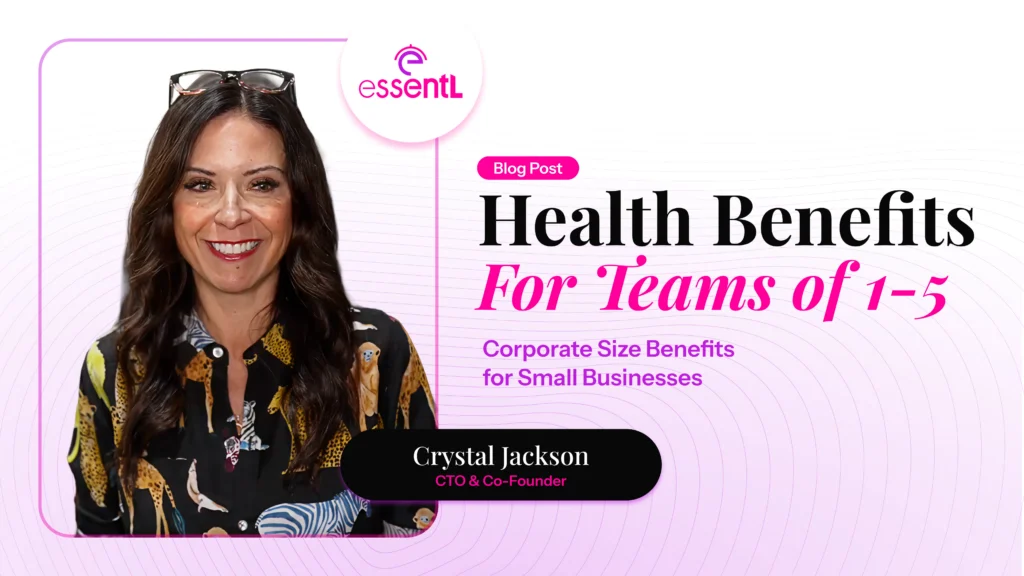
When you run a team of one to five people, health benefits can feel way more complicated than they should.
I know because I have been there.
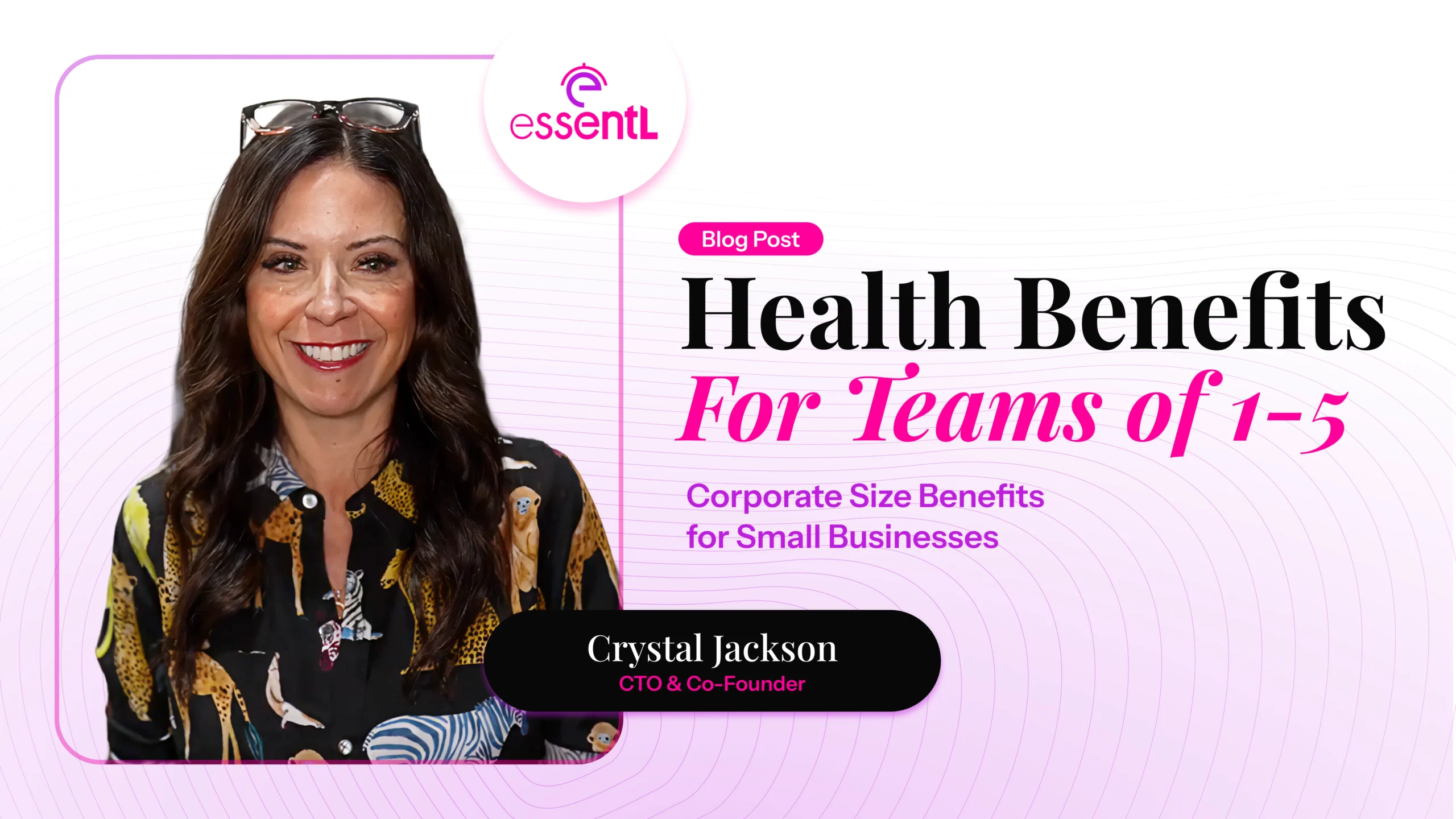
Before EssentL, I worked in a corporate environment where health insurance was just part of the package. You picked a plan, paid your portion, went to the doctor, and that was that. I had access to health, dental, vision, and the kinds of benefits people often associate with larger companies. Then…I left that world.
After I left Intel, I had to figure out health insurance on my own. I went from having a corporate benefits package to trying to understand COBRA, the individual Health Insurance Marketplace, deductibles, co-pays, co-insurance, in-network providers, out-of-network providers, and all the things nobody really explains to you until you are forced to figure it out yourself.
I remember looking at the options and thinking, “Wait. I pay this much every month, and then I still pay when I go to the doctor? And then it does not really kick in until I hit my deductible?”
It felt like every answer led to three more questions.
That experience is a big part of why EssentL exists. If you are self-employed, a freelancer, a solopreneur, a creator, or a small business owner with only a few employees, you should not have to feel like good health benefits are only available to people who work at big companies.
Evaluating Health Benefit Options for Teams of 1–5
If you are self-employed or running a small team of one to five people, your main health benefits options may include COBRA, the individual Health Insurance Marketplace, a spouse or partner’s employer plan, small group health insurance if your business qualifies, or a PEO that can help you access benefits alongside payroll and HR support.
The best option depends on your business structure, whether you have W-2 employees, whether you are the only employee, your state, your income, your family needs, your budget, and how much support you want when comparing plans.
For many freelancers and solopreneurs with no employees, HealthCare.gov explains that you can use the Health Insurance Marketplace to find coverage for yourself. For small businesses, the rules are different. Businesses with no employees other than owners or spouses generally are not eligible for SHOP plans, and to qualify for SHOP, you generally need at least one employee who is not an owner or spouse.
That distinction matters because many very small businesses fall into an awkward middle ground. You may be a real business. You may pay business taxes. You may be trying to build something serious. But if it is just you, or just you and your spouse, not every small group health insurance option may be available to you.
That gap is one of the reasons EssentL was built.
Why Health Benefits Are So Hard for Small Teams
When people search for health insurance for freelancers, health insurance for solopreneurs, or the cheapest health insurance self-employed workers can find, what they are usually looking for is not just a plan.
They are looking for clarity.
Most people are asking:
- How do I offer health benefits as a small business owner?
- Can I get health insurance if I’m self-employed?
- Can I get small business health insurance if it’s just me and my spouse?
- What is the best health insurance for freelancers?
- Can I offer health insurance if I only have one employee?
- Can I contribute to my employees’ health insurance without paying for the whole plan?
Those are normal questions.
The problem is that the system is not built to make those answers simple. If you have ever gone through the individual Marketplace or tried to compare plans line by line, you know how overwhelming it can be. Premiums, deductibles, prescription coverage, provider networks, co-pays, and out-of-pocket maximums all matter. But unless you know what to look for, it is easy to focus only on the monthly premium and miss the bigger picture.
That is why I always tell people: the “cheapest” health insurance is not always the best option. The better question is, “What is the most cost-effective option for my life, my family, my health needs, and my business?”
Option 1: COBRA
For a lot of people leaving a corporate job, COBRA is the first option they encounter.
COBRA can be helpful because it lets you continue the coverage you already had for a period of time. That can feel comforting, especially if you like your doctors or have ongoing medical needs.
The downside is cost.
When you are employed by a larger company, your employer is usually contributing toward your health insurance. When you move to COBRA, you may be responsible for much more of that total cost yourself. For many people, that monthly number is a shock.
COBRA can be a temporary bridge, but for a self-employed person, freelancer, or small business owner, it is usually not the long-term solution they are looking for.
Option 2: The Individual Health Insurance Marketplace
The individual Health Insurance Marketplace, sometimes called the ACA Marketplace or open market, is where many self-employed individuals and freelancers go next.
This can be a good option for some people. Depending on your situation, your income, your location, and the plans available to you, the Marketplace may help you find individual or family coverage. If you qualify, you may also be eligible for savings that lower your monthly premium or out-of-pocket costs.
But it can also be confusing.
When I first looked at individual health insurance options, I was overwhelmed by how different it felt from corporate benefits. At a big company, you often have a benefits department, an HR team, or at least someone who gives you a packet and explains the basics. On your own, you are suddenly responsible for comparing everything.
A lower monthly premium may come with a higher deductible. A plan that looks affordable may not include the doctors you want. A plan may work well for a healthy single person but make less sense for someone with a family, prescriptions, or ongoing care needs.
That does not mean the Marketplace is bad. It just means you need to look at the whole picture.
Option 3: A Spouse or Partner’s Employer Plan
For some solo entrepreneurs or small business owners, the best option may be joining a spouse or partner’s employer-sponsored plan.
If that is available to you, it is worth comparing.
But not everyone has that option. And even when it is available, it may not be the best financial fit. The dependent cost may be high, the network may not work for your doctors, or the coverage may not fit your family’s needs.
Again, this is why comparison matters. You do not want to assume one option is better simply because it is attached to a larger employer. You want to look at the premium, deductible, coverage, prescription needs, provider network, and total potential cost.
Option 4: Small Group Health Insurance
Small group health insurance can be a good option for some small businesses, but this is where a lot of very small teams run into roadblocks.
HealthCare.gov explains that businesses with no employees other than owners or spouses generally are not eligible for SHOP plans. To qualify for SHOP, a business generally needs between one and 50 employees and at least one employee who is not an owner or spouse.
That rule is important for solopreneurs, husband-and-wife businesses, single-owner S corporations, creators, consultants, and other very small teams.
Before EssentL was fully up and running, we were paying a lot for health insurance. I remember trying to find a small group policy that could work for us. A broker helped us look at options, and we found a plan that could have saved us a meaningful amount each month.
But then we did not qualify because of our business size.
That was one of those moments where I thought, “You have got to be kidding me.”
We were a real business. We were paying taxes. We needed health benefits. But because we did not fit neatly into the requirements for that plan, it was not available to us.
That is the exact gap so many teams of one to five fall into. You are not a large company. You may not qualify for every small group option. But you still need coverage. You still need support. And if you have employees, you may want to offer benefits that help you recruit and retain good people.
Option 5: A PEO
A PEO, or Professional Employer Organization, can help small businesses access benefits, payroll support, HR support, and other infrastructure that would normally be difficult to manage alone.
For a team of one to five, this can be especially valuable.
With EssentL, one of the things I care about most is that we can support very small businesses, including solo business owners. Maybe it is just you. Maybe it is you and your spouse. Maybe you have two employees. Maybe you are starting to grow and want to offer benefits before you become a larger company.
You should still be able to explore real options.
Through a PEO, small businesses may be able to access health benefits and other employee benefits in a more structured way. That can include medical, dental, vision, and other benefits that people often associate with larger employers.
And just as important, you are not trying to figure it out completely alone.
Founder Perspective: There Is No One-Size-Fits-All Plan
One thing I always want people to understand is that there is no one-size-fits-all answer.
The right health benefits option for a single 30-year-old with no dependents may look completely different from the right option for a married business owner with kids. Someone who rarely goes to the doctor may prioritize a lower premium. Someone with prescriptions, ongoing care, or a family may need to look more closely at deductibles, networks, and out-of-pocket costs.
That is why guidance matters.
At EssentL, we have broker support behind us that can help people look at their options. The goal is not to force everyone into the same plan. The goal is to help you understand what is available, compare the real costs, and find the best fit for your situation.
Sometimes that may be EssentL. Sometimes the Marketplace may make more sense. To me, that is not lost business. That is doing the right thing.
If someone comes to us and we help them find a better solution, even if that solution is not us, we have still done our job.
What About Employer Contributions?
For small business owners with employees, another big question is contribution.
You may want to offer health insurance, but you may not be in a position to cover everything. That is normal. Small businesses have to manage cash flow carefully.
Depending on how your benefits are structured, you may have options for how much the business contributes. Maybe you contribute a set amount. Maybe you cover a percentage. Maybe employees pay more of the cost. The important thing is understanding what is possible and setting up something that works for your business.
Offering benefits does not have to mean copying what a Fortune 500 company does. It means building something sustainable that supports your people and your business.
A Quick Tax Note for Self-Employed Business Owners
If you are self-employed, it may also be worth asking a tax professional about the self-employed health insurance deduction. The IRS provides Form 7206 to help determine any self-employed health insurance deduction you may be able to claim.
This does not mean every person or every business will qualify in the same way. Your business structure, income, plan setup, and tax situation can all matter. But it is a good example of why health benefits should not be treated as only a personal expense. For many business owners, benefits planning is also part of the larger financial picture.
This is one more reason to get the right guidance instead of guessing.
Health Benefits Are a Business Decision
For freelancers, solopreneurs, creators, and small teams, health insurance is personal. It affects your family, your finances, and your peace of mind.
But it is also a business decision.
If you are self-employed, your business has to support your life. If you have employees, your benefits can impact hiring, retention, morale, and trust. People want to know that the company they work for is thinking about their well-being.
You do not need to have hundreds of employees to start thinking that way.
In fact, I think the earlier you build the right foundation, the better.
Final Thoughts
If you are a team of one to five and you are trying to figure out health benefits, start by comparing your options.
Look at COBRA. Look at the individual Health Insurance Marketplace. Look at a spouse or partner’s plan if that applies. Look at small group options if you qualify. And look at whether a PEO could give you access to the kind of benefits and support that are usually harder for small businesses to get on their own.
But do not just look at the monthly premium.
Look at the full picture: deductibles, co-pays, prescriptions, provider networks, family needs, contribution strategy, tax considerations, and the level of support you get when you have questions.
I built EssentL because I lived the frustration of trying to figure this out myself. I knew there had to be a better way for small business owners, solo entrepreneurs, freelancers, and micro teams to access benefits without feeling like they were on their own.
Because good benefits should not only belong to big companies.
Small businesses deserve them too.
Frequently Asked Questions
Can I get health insurance if I am self-employed with no employees?
Yes. If you are self-employed with no employees, HealthCare.gov says you can use the Health Insurance Marketplace to find coverage for yourself and your family. Depending on your income and other factors, you may also qualify for savings.
Can I get small business health insurance if it is just me?
Not always. HealthCare.gov explains that businesses with no employees other than owners or spouses generally are not eligible for SHOP plans. That is why many solo business owners compare Marketplace plans, spouse or partner coverage, private options, or PEO-supported solutions.
Can a team of one offer health benefits through a PEO?
In some cases, yes. One of the reasons EssentL exists is to help very small businesses, including certain solo business owners, explore benefits options that may not be available through traditional small group paths. The right fit depends on your business structure and specific situation.
What is the best health insurance option for freelancers?
There is no single best option for every freelancer. Some freelancers may find a good fit through the Marketplace, some may use a spouse or partner’s plan, and some may benefit from a business structure that allows them to explore other options. The right choice depends on cost, coverage, network, prescriptions, family needs, and long-term business goals.
Is the cheapest health insurance always the best choice?
No. The cheapest monthly premium is not always the lowest total cost. A lower premium may come with a higher deductible, a smaller provider network, or higher out-of-pocket costs. It is important to compare the full cost of coverage, not just the monthly payment.
What benefits should a small business offer first?
Most small businesses start with core benefits like medical, dental, and vision. From there, they may consider additional benefits such as retirement plans, disability coverage, life insurance, or other voluntary benefits. The right package depends on your budget, your team, and what matters most to the people you are trying to support.
Do I need a PEO to offer health benefits?
Not necessarily. Some businesses can offer benefits without a PEO. But a PEO can be helpful when you want benefits support alongside payroll, HR, compliance guidance, and administrative infrastructure. For very small teams, that combination can be valuable because you may not have an internal HR department.
Disclaimer
This article is for educational purposes only and is not tax, legal, insurance, or benefits advice. Health insurance and employee benefits decisions depend on your state, business structure, employee status, income, and individual needs. Always consult a licensed broker, tax professional, legal advisor, or benefits professional before making decisions for your specific situation.