Payroll is usually one of the first things a business owner solves.
That makes sense. If you hire employees, they need to get paid correctly and on time. You need a system. You need direct deposit. You need pay stubs. You need tax withholding. You need some way to make sure payroll actually runs.
So a lot of small business owners start with a payroll company or payroll software.
For some businesses, that may be enough for a while.
But payroll is not the whole employment picture.
The moment you start employing people, payroll connects to a much bigger system: payroll taxes, HR compliance, employee paperwork, workers’ compensation, unemployment, benefits, state registrations, deductions, wage garnishments, employee questions, and the occasional situation you did not even know you needed to be prepared for.
That is where the difference between a payroll company and a PEO becomes important.
A payroll company helps you pay employees.
A PEO helps you manage the employment structure around those employees.
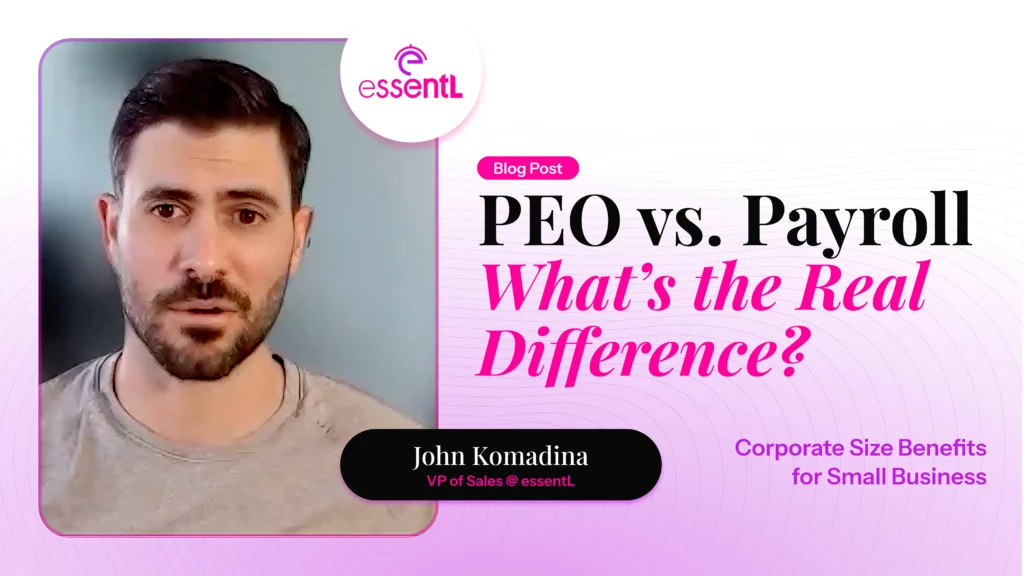
The Short Answer: What Is the Difference Between a Payroll Company and a PEO?
A payroll company helps a business process payroll. A PEO, or Professional Employer Organization, helps a business manage payroll plus the broader employment infrastructure around it. That may include payroll tax administration, HR support, benefits administration, workers’ compensation support, unemployment support, compliance guidance, employee onboarding, and employee documentation.
The simplest way to think about it is this:
Payroll is a transaction. Employment is a system.
A payroll company can be very useful for processing the transaction. A PEO helps support more of the system.
The other major difference is the relationship.
A payroll company usually operates as a vendor. You use its system or service to run payroll. A PEO works through a co-employment relationship, which outlines which employment-related responsibilities belong to the business and which are supported by the PEO.
That does not mean the PEO runs your company. You still lead the business, manage your employees, make hiring and firing decisions, set compensation, and build your culture.
The PEO helps with the employment administration that sits underneath all of that.
What a Payroll Company Usually Does
Payroll companies solve a real problem.
They help businesses pay people.
A payroll company may help calculate gross-to-net pay, process direct deposit, withhold payroll taxes, generate pay stubs, produce payroll reports, and help with certain tax filings or payments depending on the provider and setup.
Many payroll platforms also offer HR software, employee self-service portals, basic onboarding tools, templates, time tracking, contractor payments, or benefits integrations.
That can be helpful.
If you are a very simple business with a straightforward team, one state, no benefits, and few HR questions, a payroll company may be a perfectly reasonable starting point.
The problem is not payroll companies.
The problem is assuming payroll equals HR.
It does not.
Payroll is one important part of employing people. But it does not automatically mean your business is set up correctly in every state where you hire. It does not automatically mean your workers’ compensation, unemployment, benefits administration, employee documentation, or HR compliance questions are handled.
And that is usually where small business owners begin to feel the gap.
What a Payroll Company May Not Do
A payroll company may help you process what you put into the system.
But it may not always stop you from making a decision that creates a compliance issue somewhere else.
For example, if you hire someone in a new state, your payroll provider may be able to pay that employee. But does that mean your business is properly registered in that state? Does it mean your unemployment account is set up correctly? Does it mean workers’ compensation is handled? Does it mean the right employee notices, onboarding documents, and state-specific requirements are in place?
Not necessarily.
That is the difference between payroll processing and employment support.
A payroll company may not provide full HR compliance guidance. It may not manage employee handbooks. It may not help you handle an unemployment issue. It may not guide you through a termination question. It may not flag every multi-state employment issue. It may not help you understand whether your benefits, deductions, payroll taxes, workers’ compensation, and employee documentation are connected the way they should be.
Some payroll companies offer additional HR features, and some are more robust than others. But the business owner needs to understand what is included, what is not, and what still falls on them.
That is the key question.
Not “Can this system run payroll?”
But “What happens if something around payroll gets complicated?”
What a PEO Adds Beyond Payroll
A PEO includes payroll, but it does not stop there.
A PEO can help with payroll administration, payroll tax support, employee onboarding, benefits administration, workers’ compensation support, unemployment support, HR compliance guidance, employee documentation, and access to HR support when questions come up.
That broader structure matters because employment issues rarely stay in one lane.
A payroll question may become a tax question.
A hiring decision may become a state compliance question.
A termination may become an unemployment question.
A benefits deduction may become a payroll question.
An employee issue may become an HR documentation question.
A PEO is designed to help support those connections.
That is one reason a PEO can be so valuable for small businesses. Most small companies do not have a payroll department, HR department, benefits department, compliance team, and legal team sitting down the hall.
The founder is often trying to manage all of it.
A PEO gives that founder a stronger employment foundation without requiring them to build a full internal HR department from scratch.
The Co-Employment Difference
The real structural difference between a payroll company and a PEO is co-employment.
With a payroll company, the provider is usually a vendor. The business uses the provider to run payroll or access payroll-related tools.
With a PEO, the business enters into a co-employment relationship. That agreement outlines the responsibilities of the business and the responsibilities of the PEO. The PEO may take on or share certain employment-related responsibilities, such as payroll administration, payroll tax administration, benefits administration, workers’ compensation, unemployment support, and HR compliance support.
That can sound more complicated than it feels in practice.
The business owner still runs the business. The owner still decides who to hire, who to let go, how to manage the team, what the company sells, how the company operates, and where the company is going.
The PEO helps manage the employment administration that supports the team.
For many small business owners, that is the part they wanted help with in the first place.
They do not want to become experts in every HR acronym, payroll rule, state registration question, or benefits administration issue. They want to know the employment side of the business is being handled so they can focus on the business they actually started.
Example: Payroll Taxes Can Still Become a Founder Problem
One of the most frustrating situations for a small business owner is believing something has been handled, then discovering later that it was not.
EssentL has spoken with business owners who believed their payroll tax obligations were being handled through a large payroll provider, only to later discover an issue and receive a significant government bill.
In one example, a business owner was trying to track down what happened after being told there was roughly $20,000 owed in payroll taxes. From the owner’s perspective, they had relied on their payroll provider. But when the issue surfaced, they were the one stuck trying to get answers, contact support, find the right department, and understand what happened.
That kind of situation is stressful because payroll taxes are not optional. If there is a problem, the business owner cannot simply ignore it.
This is one of the reasons support matters.
A large payroll provider may serve many thousands of businesses. If you are a small company, you may end up in a support queue, an 800-number loop, or a chain of emails trying to figure out where the issue lives.
With a PEO, the goal is a more integrated support structure. Payroll is still part of the equation, but it is connected to a broader employment relationship where the PEO has more involvement in helping the business manage the employment side correctly.
Example: Wage Garnishments Are Not Just a Button
Another example is wage garnishment.
For many founders, wage garnishment is not something they think about until it happens.
If an employee has wages garnished for something like child support, the employer may be responsible for withholding the correct amount and sending it to the appropriate agency on schedule. That may involve notices, calculations, separate portals, deadlines, and documentation.
It is not just a normal paycheck anymore.
For a small business owner, that can feel stressful quickly. You are not only paying the employee. You are making sure the garnishment is handled properly and that the business does not miss an obligation.
That is the kind of payroll-related issue that shows why payroll can become more complicated than it looks.
A payroll system may help process a deduction, but the founder may still need to understand what needs to happen, when, and why. A PEO can help reduce the amount of manual administrative work the business owner is personally managing around these kinds of employment issues.
When Is a Payroll Company Enough?
A payroll company may be enough for some businesses.
That is important to say clearly.
If your business is simple, your team is small, everyone works in one state, you are not offering benefits, you are comfortable handling HR and compliance separately, and you mainly need a way to pay employees, payroll software or a payroll company may be a good fit.
Not every business needs a PEO on day one.
Some founders are comfortable managing the rest of the employment structure themselves. Some have an internal HR person. Some have an attorney, CPA, broker, or advisor helping them with pieces of the puzzle. Some are not ready to offer benefits or expand across state lines.
In those cases, payroll may solve the immediate need.
The important thing is to be honest about what payroll is solving and what it is not.
If all you need is paycheck processing, payroll may be enough.
If you need support around payroll, HR, benefits, compliance, workers’ compensation, unemployment, employee documentation, and multi-state employment questions, you may need more than payroll.
When Have You Outgrown Your Payroll Company?
Many businesses do not outgrow payroll all at once.
They outgrow it slowly.
At first, everything seems fine. Payroll runs. Employees get paid. The system works.
Then the business hires in another state.
Then someone asks about benefits.
Then a founder realizes workers’ compensation needs attention.
Then an employee leaves and files for unemployment.
Then a payroll tax question comes up.
Then someone asks an HR question the founder does not know how to answer.
Then the business starts Googling employment rules at 10 p.m.
That is usually the moment payroll starts to feel too small.
You may have outgrown payroll-only support if the paycheck part works, but everything around payroll feels messy.
Signs you may be ready to look at a PEO include:
You are hiring across state lines.
You want to offer employee benefits.
You are spending too much time on HR questions.
You are unsure about workers’ compensation.
You are dealing with unemployment claims.
You are manually managing employee paperwork.
You are relying on Google for HR compliance answers.
You need more human support than your current provider offers.
You want to build a stronger foundation before the team grows further.
The question is not just whether your employees are getting paid.
The question is whether the employment side of your business is actually supported.
Why Small Businesses Can Get Lost With Bigger Providers
Large providers can be great for large companies.
But small businesses often need something different.
A company with one, three, five, or ten employees may not have the volume or complexity that makes it a priority for a large provider. That does not mean the small business has small problems. It just means it may not get the level of support it needs.
For a founder, that can be frustrating.
You may have a real payroll issue, a real benefits question, a real compliance concern, or a real employee problem. But if you are routed through a help center, ticketing system, or generic support line, the process can feel impersonal.
Small businesses need more than software.
They often need someone who will help them understand what is happening, what the options are, and what steps to take next.
That is one of the reasons EssentL was built for small teams.
A very small business still deserves real support. In fact, when you do not have an internal HR department, that support may be even more important.
Payroll Company vs. PEO: Side-by-Side
Here is a simple way to compare the two.
| Business Need | Payroll Company | PEO |
| Process payroll | Yes | Yes |
| Calculate pay and deductions | Yes | Yes |
| Generate pay stubs | Yes | Yes |
| Payroll tax administration | Often, depending on setup | Yes, with broader employment support |
| HR compliance support | Limited or add-on | Typically part of the relationship |
| Employee benefits | May be limited, separate, or integrated through partners | Often integrated into the PEO structure |
| Workers’ compensation support | Usually separate or limited | Often supported through the PEO relationship |
| Unemployment support | Limited | Often supported |
| Employee onboarding documents | Basic tools or templates | More structured support |
| Multi-state employment guidance | Limited | More comprehensive support |
| Human HR support | Varies | Core part of the value |
This table is not meant to say one is always better than the other.
It is meant to show that they are not the same thing.
A payroll company helps with payroll. A PEO helps with payroll and the broader employment responsibilities that surround it.
The Founder’s Real Decision
The real decision is not “payroll company or PEO?”
The real decision is, “What level of employment support does my business need right now?”
If you only need to pay employees, payroll may be enough.
If you are trying to build a more complete employment foundation, a PEO may be worth exploring.
That foundation matters because businesses rarely stay simple forever. Hiring creates new responsibilities. Benefits create new administration. Multi-state employees create new compliance questions. Employee issues create documentation and process needs. Growth creates more moving parts.
Payroll is one part of the foundation.
But employment is bigger than payroll.
A PEO helps small business owners think about the full system, not just the paycheck.
Why EssentL’s Approach Is Different
EssentL was built for small businesses that may not be well served by traditional employment solutions.
Many small teams are too small for larger PEOs to prioritize. Some are too early for a full HR department. Some are trying to offer benefits for the first time. Some are hiring their first employee. Some have already outgrown payroll software but do not know what the next step should be.
EssentL helps business owners understand their options.
That does not mean a PEO is always the answer for every company at every stage. Sometimes payroll may be enough. Sometimes a business may need to compare options. Sometimes the right move is simply understanding what responsibilities are currently sitting with the founder.
The goal is to make the employment side of the business clearer.
Because once you understand the difference between payroll-only support and PEO support, you can make a better decision for your team.
Understanding the Core Differences: PEO vs. Payroll Company
Payroll companies are useful.
They help businesses pay employees, manage payroll runs, generate pay stubs, and handle important payroll functions.
But payroll is not the same thing as HR. It is not the same thing as benefits administration. It is not the same thing as workers’ compensation support, unemployment support, compliance guidance, employee documentation, or having someone to call when an employment issue comes up.
A payroll company helps you pay your employees.
A PEO helps you support the employment side of your business.
If your current payroll solution is working and your business is simple, you may not need to change anything yet. But if you are hiring, growing, offering benefits, dealing with multiple states, answering HR questions, or feeling like everything around payroll is getting harder to manage, it may be time to look at what a PEO can offer.
If you are not sure whether payroll alone is still enough for your business, EssentL can help you understand what support could look like as your team grows.
Frequently Asked Questions
What is the difference between a payroll company and a PEO?
A payroll company helps businesses process payroll. A PEO helps businesses manage payroll plus broader employment-related functions such as HR support, benefits administration, compliance guidance, workers’ compensation support, unemployment support, and employee documentation.
Is Gusto a PEO?
Gusto is commonly known as a payroll and HR platform. Businesses comparing Gusto vs. a PEO should look at whether they need payroll software only or a more complete employment support structure that includes payroll, benefits, HR support, compliance guidance, workers’ compensation support, and unemployment support.
Is ADP a PEO?
ADP offers payroll services, and ADP TotalSource is its PEO offering. When comparing ADP vs. a PEO, it is important to clarify whether you are comparing a payroll product or a PEO service, because those are not the same thing.
What does a payroll company not do?
A payroll company may not provide full HR compliance support, benefits administration, workers’ compensation support, unemployment support, employee handbook support, or multi-state employment guidance. The exact services depend on the provider and plan.
When should a small business upgrade from payroll to a PEO?
A small business may consider a PEO when it starts hiring across states, wants to offer benefits, needs HR support, is spending too much time on compliance questions, or has outgrown basic payroll software.
Is a PEO better than a payroll company?
Not always. A payroll company may be enough for a simple business that mainly needs paycheck processing. A PEO may be a better fit when the business needs payroll plus HR support, benefits, compliance guidance, workers’ compensation, unemployment support, and employee administration.
Can a PEO help with payroll taxes?
Yes. A PEO can help administer payroll taxes as part of its broader employment support. Business owners should always understand how payroll tax responsibilities are handled in their specific agreement.
Disclaimer
This article is for educational purposes only and is not legal, tax, insurance, payroll, or HR advice. Payroll and employment obligations vary by state, business structure, employee status, provider agreement, and individual circumstances. Always consult qualified legal, tax, HR, payroll, benefits, or insurance professionals before making decisions for your specific business.