
California is one of the most rewarding states to build a business. It is also, without question, one of the most complicated states to be an employer in. The penalties for getting it wrong can hit $10,000 or more per violation before you even factor in potential lawsuits.
I talk to small business owners every day, and California compliance is one of the most common things that catches them off guard. Not because they are careless, but because they are focused on running their business. Reading up on annual law changes isn’t exactly what most founders signed up for.
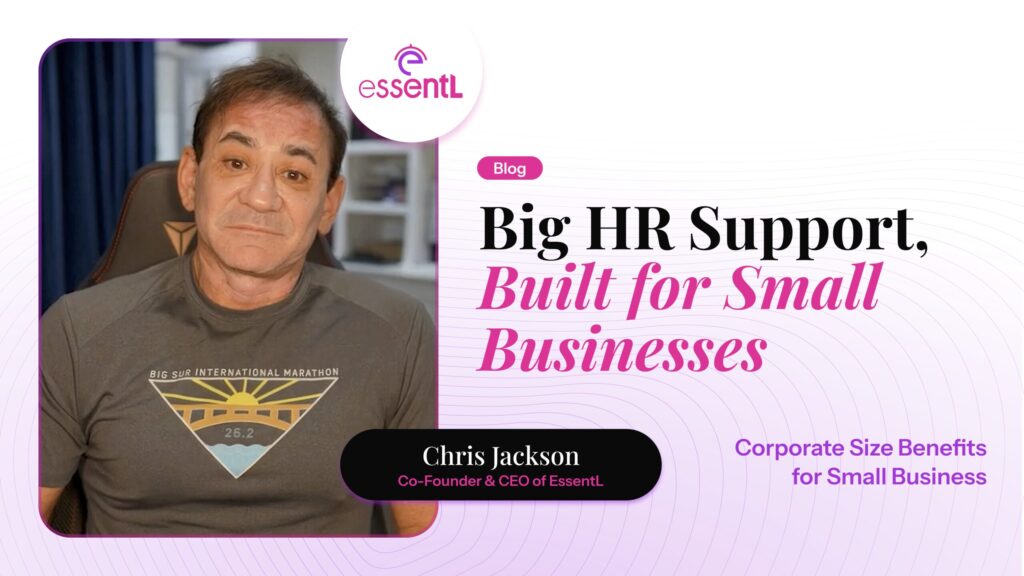
So I sat down with Crystal and Chris Jackson, the co-founders of EssentL, to break down what California employers actually need to know in 2026 in plain language, without the noise.
Why California Is in a League of Its Own
John: Crystal and Chris, why is California such a tough state for small business owners when it comes to HR?
Crystal: California is just in a league of its own when it comes to employment law. The rules go way beyond what federal law requires, and a lot of them kick in at much smaller employee counts than most business owners expect. Like, you don’t need to have 50 people before these rules start applying to you. Some of them apply the moment you have one employee. I think it’s easy to be blindsided as a small business owner because you’re busy focusing on your company, you’re not reading up on every new rule California puts out. I lived that. We had multiple businesses over the years and I can tell you it was a nightmare trying to figure out what’s the law and what I have to do. You basically need a full-time person who actually understands HR regulations and California employment law just to stay within those regulations. That’s why we built EssentL.
Chris: Every regulation you see in California has a history behind it. Workers’ comp came about because there was a time when you got hurt on the job and everyone said, that’s too bad, I guess you lose your job. The employee handbook requirements exist because there was a time when employers could operate without any accountability. These structures came about because they work. Compliance isn’t just about following the law. It’s about building a business that can actually operate without blowing up when something goes wrong.
That framing matters because it changes how you think about compliance. It isn’t red tape. It’s infrastructure.
What Every California Employer Must Do, No Matter the Size
Some California requirements apply to every employer the moment they have a single employee. These are the non-negotiables, and they don’t care how big or small your team is.
Minimum wage. As of January 1, 2026, the statewide minimum is $16.90 per hour. But a lot of cities and counties set their own higher rates. Los Angeles, San Francisco, San Jose, Santa Monica, and dozens of others all have local minimums above the state floor. If you run your business in one of those cities, you may owe more than the state minimum. There are industry-specific rates too. Fast food workers must be paid at least $20 per hour, and healthcare workers at covered facilities are on a path to $25 per hour by July 2026.
Workers’ comp. All California employers must carry workers’ comp coverage. There are no exceptions and no minimum employee count. Even if you have one employee, you need it.
Labor law posters. Employers are required to display both federal and California labor law posters somewhere employees can see them. If you have remote workers, you need to provide electronic access. It sounds simple but it gets missed constantly.
John: Crystal and Chris, can you shed some light on how important it is to understand these California rules?
Crystal: So we had a potential client come in who had employees in California even though they were headquartered in another state, and they didn’t know they had to have workers’ comp for those employees. Yeah, you do. If you don’t, you can get in real trouble.
Chris: Exactly, if you have a person within the borders of the state, California’s employment law applies to that person. It doesn’t matter where your business is headquartered.
Requirements That Kick In as You Add Employees
The thresholds are lower than most business owners expect. Here is where things escalate as your team grows.
Paid sick leave applies to any employee who works 30 or more days in a year. California requires at least 40 hours, which is 5 days, per year.
Meal and rest breaks are required for all employees. Anyone working more than 5 hours must get a 30-minute unpaid meal break. After 10 hours, a second one kicks in. All employees are also entitled to a paid 10-minute rest break for every 4 hours worked. If you fail to provide a required break, the employee is owed one additional hour of pay at their regular rate. As Crystal put it: “That adds up super fast.”
At 5 employees, two significant requirements kick in.
The first is harassment prevention training. Supervisors need 2 hours of training and all other employees need 1 hour. It has to happen within 6 months of hire or promotion into a supervisory role and must be repeated every 2 years. Crystal sees this missed constantly: “A lot of owners don’t realize the threshold is just 5 employees. They’re thinking of some big number like 50. It’s 5.”
The second is the California Family Rights Act, or CFRA. Federal FMLA doesn’t kick in until 50 employees, but California’s version kicks in at 5. If you have 5 or more employees, eligible workers can take up to 12 weeks of unpaid, job-protected leave for a new child, a serious health condition, or caring for a family member. You need a written CFRA policy, and you need to know how to respond to a leave request properly. Denying a valid one is a violation.
John: Chris, what is one common mistake you see small business owners making before they join EssentL PEO?
Chris: As soon as you hire one person, you have to have an employee handbook by law. So I ask, do you have a handbook? A lot of them go, “I didn’t even know I needed one”. I also ask, do you have an employee rights poster somewhere the employee can see it? You don’t? You can be fined! The small business owner who says they’ll deal with compliance later is the one who ends up with fines, lawsuits, and stress that was completely avoidable.
What’s New in 2026: The Updates You Need to Act On
There are a few updates in 2026 that I think are really important. The biggest one is the Annual Know Your Rights Notice, which came from SB 294. Starting this year, employers must give every employee a written notice every year covering their wage rights, leave rights, workplace safety information, emergency contacts, and where to get help. The first notice was due February 1, 2026. New hires need to get it going forward. The penalties are not small. Up to $500 per employee for a first violation and up to $10,000 per employee for ongoing violations. Keep signed receipts on file and set a recurring calendar reminder. It’s actually easy to comply with once you know about it.
Another important one is AB 692, which bans most stay-or-pay agreements as of January 1, 2026. You generally can’t include clauses in employment contracts that require employees to repay training costs or relocation expenses if they leave before a certain date. If you have anything like that in your offer letters or employment agreements, you need to review those now.
And if you have 15 or more employees, SB 642 expanded California’s pay transparency requirements. Job postings now need to include not just base salary ranges but also bonuses, commissions, and equity compensation. I’d also recommend doing an internal pay equity review so you actually know where you stand.
Worker Classification: The Mistake That Costs the Most
This is one of the most expensive mistakes I see, and it happens more often than it should.
California uses what’s called the ABC test. Under this test, a worker is assumed to be your employee unless you can prove all three of the following: A) the worker is free from your control in how they do the work, B) the work they do is outside the usual course of your business, and C) the worker has their own independently established trade or business.
John: Crystal & Chris, can you explain how this worker classification can trip people up?
Crystal: That B prong is the one that trips people up most. If you run a marketing agency and you hire a ‘freelance’ marketer, they almost certainly fail that test because marketing is your core business. ‘They prefer a 1099’ is not a legal justification. Enforcement has only increased, and the consequences include back taxes, back benefits, and penalties.
Chris: The same pattern applies to the creator and small business world. Someone’s based in LA, they hired an assistant, a cameraman, whatever, and they just made everyone a 1099 subcontractor. You can’t do that. There are very specific rules in California for 1099. An assistant? That’s not really a specialty job. Anyone could be an assistant. California will come for you on that.
If you have contractor relationships that you’re not totally confident about, review them now. The risk of getting this wrong is too high to leave unexamined.
The Most Common Mistakes California Small Businesses Make
In nine years of working with small business owners on compliance, I’ve watched the same five mistakes come up over and over again.
Not doing harassment prevention training. The threshold is 5 employees, not 50. A lot of owners either haven’t done it or can’t prove they did. Both are problems.
Misclassifying workers as independent contractors. We just covered this one. Really common, really costly.
Skipping or shortening meals and rest breaks. Scheduling pressure causes this all the time. Each violation costs one additional hour of pay per employee per day. It adds up faster than you think.
Using an outdated employee handbook or having no handbook at all. California employment law changes every single year. If yours hasn’t been updated recently, it is almost certainly out of compliance. Not having one is its own violation.
Ignoring local ordinances. Minimum wage, paid leave, and scheduling rules vary by city. Compliance with state law alone may not be enough if you’re operating in Los Angeles, San Francisco, or San Jose.
How a PEO Solves the California Compliance Problem
California HR compliance is genuinely complicated, and it changes every year. For a business owner who is also running operations, serving customers, and trying to grow, staying on top of every requirement is a full-time job in itself.
John: Crystal and Chris, for business owners who are feeling overwhelmed by all of this, what’s the actual solution?
Crystal: I completely understand that feeling because I lived it. We had businesses for over 14 years and I went to work for the state for a while just for the health benefits and the stability. That is how frustrated I was. The honest answer is that California employment law is genuinely complicated and it changes every single year. For a business owner who is also running operations and serving customers and trying to grow, staying on top of every requirement is a full-time job in itself. This is exactly why I built EssentL. A PEO handles HR compliance on your behalf. It tracks law changes, updates your policies, manages your employee handbook, administers leave, and makes sure your payroll practices are clean. You don’t have to become a California employment law expert because we are the partner who does it for you. We are currently operating in 15 states, and if you have a remote employee somewhere we’re not yet registered with, we can get set up in a matter of weeks. All of that HR madness, I don’t want to deal with it, and neither should you.
Chris: Every large corporation has an HR department. Not because it’s fun, but because it’s the most efficient way to operate. A small business owner who wants to grow is going to have to do this at some point. You can either do it yourself, which is a nightmare, or you work with us and we just do it for you. And here’s something a lot of people don’t think about: being incorporated and being compliant protects you personally. If you get sued, they can’t reach through the corporate structure and take your house. These things are not just obligations. They are tools.
EssentL Was Built for This
Traditional PEOs have historically turned away teams under 5 to 10 employees. That means the small businesses that arguably need compliance support the most, the lean teams, the solo founders, the two-person operations in California trying to do everything right, have had no good option.
EssentL starts at a team of one. Whether you’re a solo founder who wants to do this right from the beginning, or a team of 15 trying to get compliant without hiring a dedicated HR person, EssentL was built for you.
California compliance doesn’t have to feel this scary. It just requires the right system and the right partner.
Steps to Get Compliant Right Now
- Audit your current setup. Go through each section of this guide and identify where your gaps are. Minimum wage, workers’ comp, meal and rest breaks, harassment training. Check them off one by one.
- Update or create your employee handbook. If you don’t have one, get one. If yours hasn’t been updated recently, it needs a review. California law changes every year.
- Check your worker classifications. Review any 1099 relationships you have and run them against the ABC test. If you’re not sure, get a second opinion before California enforcement makes that decision for you.
- Make sure the 2026 Annual Know Your Rights Notice is done. The first notice was due February 1, 2026. New hires need it going forward. Keep signed receipts on file.
- Review your offer letters and employment agreements for AB 692. Remove any stay-or-pay clauses that are no longer permitted.
- Talk to a PEO or employment attorney. If the list above feels like a lot to manage on top of running your business, that is exactly the problem a PEO exists to solve.
Don’t wait until something goes wrong to figure this out. The fines are real, the lawsuits are real, and the stress of being out of compliance is completely avoidable.
If you think EssentL might be the right fit for your business, reach out and I’ll walk you through your specific situation personally. No jargon, no pressure. Just real answers for what your business actually needs.
And if you’ve navigated California compliance and found something that worked or really didn’t, drop it in the comments. This is a topic where real experience matters, and I’d love to hear what small business owners are actually dealing with out there.